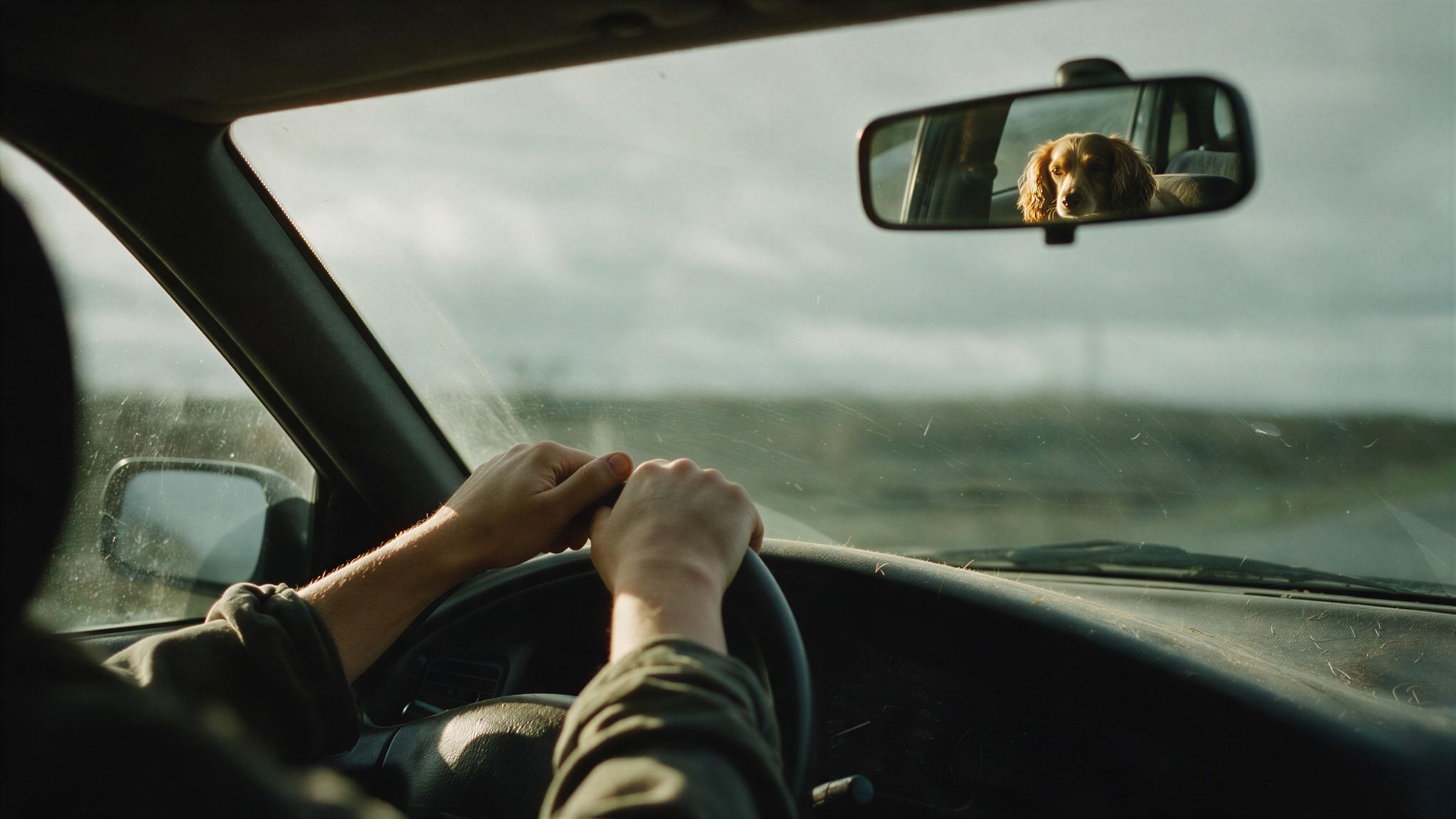
To keep a dog in the back seat of a car, clip a tether from its harness to a belt anchor, shorten the tether until the dog can sit, stand and lie down but cannot reach the front, and give it a defined surface it prefers to sit on. A dog that wanders forward is usually under-tethered rather than badly behaved.
Why does a dog climb into the front?
Because the front is the more interesting place to be, and nothing is stopping it. The driver is there, the windscreen is there, and the gap between the two front seats is a clear route with no barrier across it. Dogs also move toward whoever is talking. If the person in the driver’s seat is the person the dog attends to most, the rear bench is a waiting room and the front is the event.
A second reason is footing. A rear bench is upholstered, sloped slightly toward the back, and slippery under paws on a bend. A dog that cannot brace itself will shuffle around looking for a position that holds, and the footwell often wins because it has walls. A dog in the footwell is out of sight and hard to get back without stopping.
What actually holds a dog on the back seat?
A tether of the right length, attached to a harness. That is the mechanism, and almost everything else is comfort around it. The tether does not need to be tight. It needs to be short enough that the dog’s shoulders cannot pass the front edge of the bench, which in most cars means considerably shorter than the straps sold with many tethers.
Set the length with the dog sitting where you want it to end up. Let the dog stand, turn, and lie down. If at full stretch it can put its front feet on the centre console, the tether is longer than it should be. Shorten it and repeat. The point at which a dog stops testing the front is usually the point at which reaching it stops being worth the effort.
Where should the tether clip attach?
To a harness, across the chest and behind the shoulders, never to a collar. A collar concentrates every load on the neck, and a dog that lunges sideways against a collar is doing so against its own windpipe. A harness spreads that across the ribcage. This holds whether the drive is five minutes or five hours, and it is the single change most worth making if you currently clip to a collar.
At the vehicle end, use a belt anchor or a fixed loop rather than a headrest post. Headrest posts are adjustable by design, and a strap that can slide up the post can slide off it.
Does a barrier work instead?
A barrier works for a different problem. A rigid barrier across the front of the rear bench, or a cargo barrier behind it, stops a dog moving between compartments and is genuinely effective at that. What it does not do is stop a dog moving around within its own compartment, so a dog that paces on the bench will keep pacing. Barriers and tethers solve adjacent problems and a lot of people who bought one actually wanted the other.
Barriers also fit badly in a lot of cars. Sloped rooflines, curtain airbags along the pillars and non-standard headrest spacing all get in the way, and a barrier that is wedged rather than fitted is a barrier that moves.
How do you stop a dog jumping into the footwell?
Raise the surface it is sitting on, or fill the footwell. Those are the two approaches and they work for different dogs. A booster seat lifts a small dog above the level of the door line so it can see out of the window rather than at the back of a seat, and small dogs that can see out are markedly less inclined to go looking for a better view. A footwell filler — a rigid platform or a firm bag — removes the destination entirely.
A raised surface has a second effect that matters more than it sounds. It gives the dog a defined edge. Dogs settle faster on a surface with a boundary they can feel than on an open bench, which is why a dog that will not settle on a rear seat will often fall asleep in a box on the same seat.
If you are considering a booster for this, read what the Gemnye seat is and is not first. It is a containment and comfort seat. It raises a small or medium dog and gives it a defined space, and it is not a crash restraint and has not been through any independent testing programme, because no booster of this type has.
Does the law require any of this?
In most of the United States, no. Of the fifty states and the District of Columbia, none of the jurisdictions whose official code could be read carries a general requirement that an animal in a moving vehicle be restrained. Hawaii is the closest thing to an exception: § 291C-124(b) bars a driver from holding an animal in their lap or allowing one in the driver’s immediate area where it interferes with control of the vehicle.
What does exist nearly everywhere is a careless or inattentive driving statute, and several states name animals in their own driver guidance. Maryland’s highway safety office lists “other passengers, including children and animals” among the things that take attention off the road. Oregon’s driver manual tells drivers not to hold an animal in their lap or arms while driving.
The full position, jurisdiction by jurisdiction with the statute linked, is on dog restraint laws by US state.
How long does it take a dog to settle?
Longer than one drive, and less time than most people give it. A dog that has learned that the car means a tether it fights will keep fighting the tether. The usual sequence that works is: tether on with the engine off and the doors open, a few minutes, then off. Repeat with the engine running. Then a drive of two or three minutes ending somewhere good. The mistake is to make the first tethered journey the long one.
Feed the dog on the seat if it will eat there. A surface where food happens becomes a surface worth staying on, and that does more for a reluctant dog than any amount of correction from the front.
Sources
Read 21 August 2026. Each links to the official page it came from.
- Hawaii Revised Statutes § 291C-124, obstruction to driver’s view or driving mechanism — Hawaii State Legislature
- Common causes of distracted driving — Maryland Highway Safety Office
- Oregon Driver Manual, safe and responsible driving — Oregon Department of Transportation
- Restraint, distraction, cruelty and open truck bed law across all 51 US jurisdictions — dog restraint laws by US state, reviewed 21 August 2026