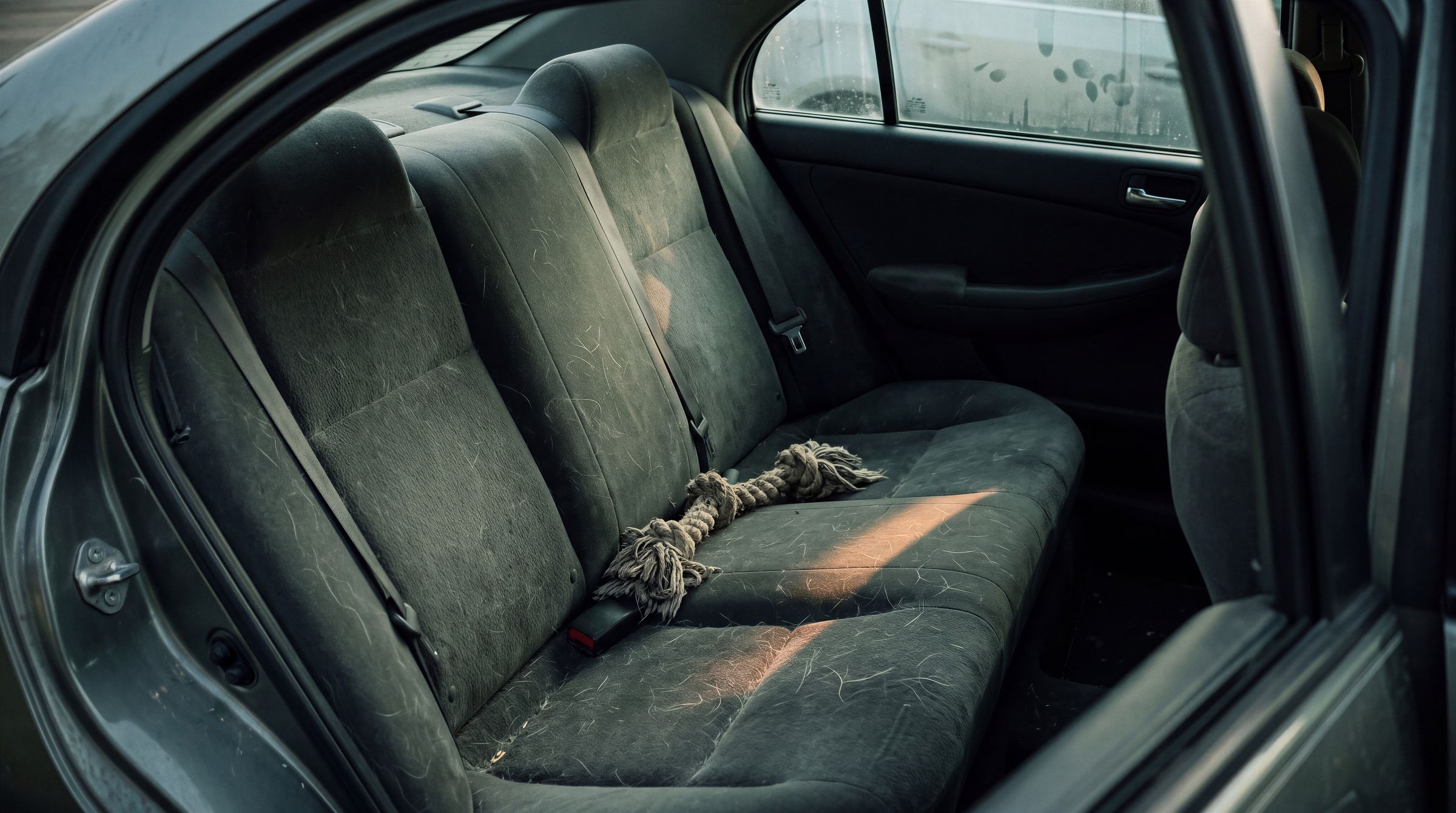
To wash a dog car seat cover, remove the hair first with a rubber glove or a pumice stone, unzip and remove the cover from any frame or foam, wash it cool on a gentle cycle with a mild detergent, and air dry it flat and fully before refitting. Skipping the hair step is what clogs machines, and heat is what shrinks covers and damages coatings.
Do you take the cover off, or wash the whole thing?
Take the cover off if it comes off. A removable cover is designed to be washed on its own, and washing a whole seat with its foam and frame inside soaks a structure that was never meant to be saturated and will take days to dry properly. Foam that stays damp in the middle develops a smell that outlasts whatever you were washing out.
If the cover does not come off, the honest answer is that you are spot cleaning rather than washing, and the section further down covers that.
How do you get the hair off first?
With friction and rubber, not with water. Water turns loose hair into a mat that bonds to fabric and then to the inside of your machine, so every method below belongs before the cover goes anywhere near a sink.
A damp rubber washing-up glove is the most effective tool most people already own. Put it on, dampen it slightly, and drag it across the fabric in one direction. Hair balls up and lifts. A rubber pet brush, a pumice stone or a window squeegee do the same job. Lint rollers work on a light coat and give up on a heavy one.
Vacuum afterwards with a brush attachment, going across the weave rather than along it. Quilted covers hold hair in the seams and the seams need their own pass.
What temperature and cycle?
Cool water, gentle or delicate cycle, mild liquid detergent, no fabric conditioner. Thirty degrees Celsius, or the cold setting, is the right default for anything you cannot verify.
Fabric conditioner is the item people are most surprised by. It leaves a coating that reduces a fabric’s ability to shed liquid, so a water-resistant face fabric comes out of a conditioner wash less water-resistant than it went in. Skip it. The same goes for bleach and for anything marketed as an oxygen brightener, which will lift colour out of a dyed velvet or a piped edge.
Turn the cover inside out if the outer face is the delicate one, and wash it on its own rather than with a household load. A zip running against other fabric for a full cycle does damage in both directions.
Should it go in a dryer?
No. Air dry flat, out of direct sun, and let it dry completely before it goes back on the frame.
Tumble drying is the single most common way these covers are ruined. Heat shrinks the shell relative to the foam it has to fit over, so a cover that fit before the wash will not stretch back around the frame afterwards. Heat also degrades any laminate or coating on the reverse of a water-resistant face fabric, and that damage is not visible until the next time you want the fabric to shed something.
Flat is better than a line because a heavy wet cover hung over a rail dries with the weight of the water pulling the shape out of it. Lay it on a rack or over a clothes horse so the load is spread.
How do you spot clean without a full wash?
Blot rather than rub, work from the outside of the mark inward, and use as little liquid as will do the job. Rubbing pushes whatever it is deeper into the weave and abrades a pile fabric so the cleaned patch ends up a different texture from everything around it.
For an ordinary muddy-paw mark: let it dry completely, break it up and vacuum it, and only then deal with what is left with a damp cloth. Wet mud spreads. Dry mud lifts. This is counterintuitive and it is right.
For a greasy mark, a drop of mild detergent in warm water on a cloth, blotted and then blotted again with a clean damp cloth to lift the detergent back out. Detergent left in fabric attracts dirt and the patch re-soils faster than everything around it.
What about the frame, the base and the straps?
Wipe them, do not soak them. A rigid internal frame, an anti-slip base and webbing straps with metal hardware all take a damp cloth and mild detergent happily and none of them benefit from immersion. Dry the hardware rather than leaving it to air, because snap hooks and adjusters are the parts that will corrode.
Check the stitching and the hardware while you have the cover off. This is the only moment you will look closely at it, and a strap that is fraying or an adjuster that has started to slip is much easier to notice on a table than on a rear bench.
What does the Gemnye cover specifically take?
Pending — this paragraph is deliberately unwritten. Gemnye has not yet confirmed the wash instructions for this seat, and the specific answers are unresolved: whether the cover is removable, whether the velvet face fabric is coated or laminated, and what wash temperature the treatment tolerates. A coated face fabric often cannot take the temperature a plain one can, which is why this is a real question rather than a formality.
The manufacturer has been asked. Until the answer arrives, the general method above is what this page will say, and the product page’s care section says the same thing: we are asking rather than guessing. The outer fabric is specified as water-resistant, and that is as far as the specification goes — there is no figure and no named test behind it, so treat the fabric as something that sheds rain and wipes down rather than as something to test in a sink.
If you own the seat and want the answer as soon as it exists, it will appear in the materials and care section of the seat’s page.
How often is worth doing?
Less often than you would think for the cover, more often than you would think for the hair. A full wash every few months is enough for most dogs. A hair pass with a rubber glove every week or two is what actually keeps the thing pleasant, takes two minutes, and removes most of the reason people wash covers in the first place.
Between washes, a folded towel or a small blanket over the sitting surface takes the worst of the mud and goes in an ordinary household load. It is a less elegant answer than a technical fabric and it is the one that keeps the technical fabric in good condition longest.
Sources
Read 21 August 2026.
- Gemnye materials and care, including the wash instructions still outstanding — the seat
- Outstanding manufacturer questions, including the fabric treatment and wash temperature — recorded in the project’s open items and repeated on the product page rather than answered here