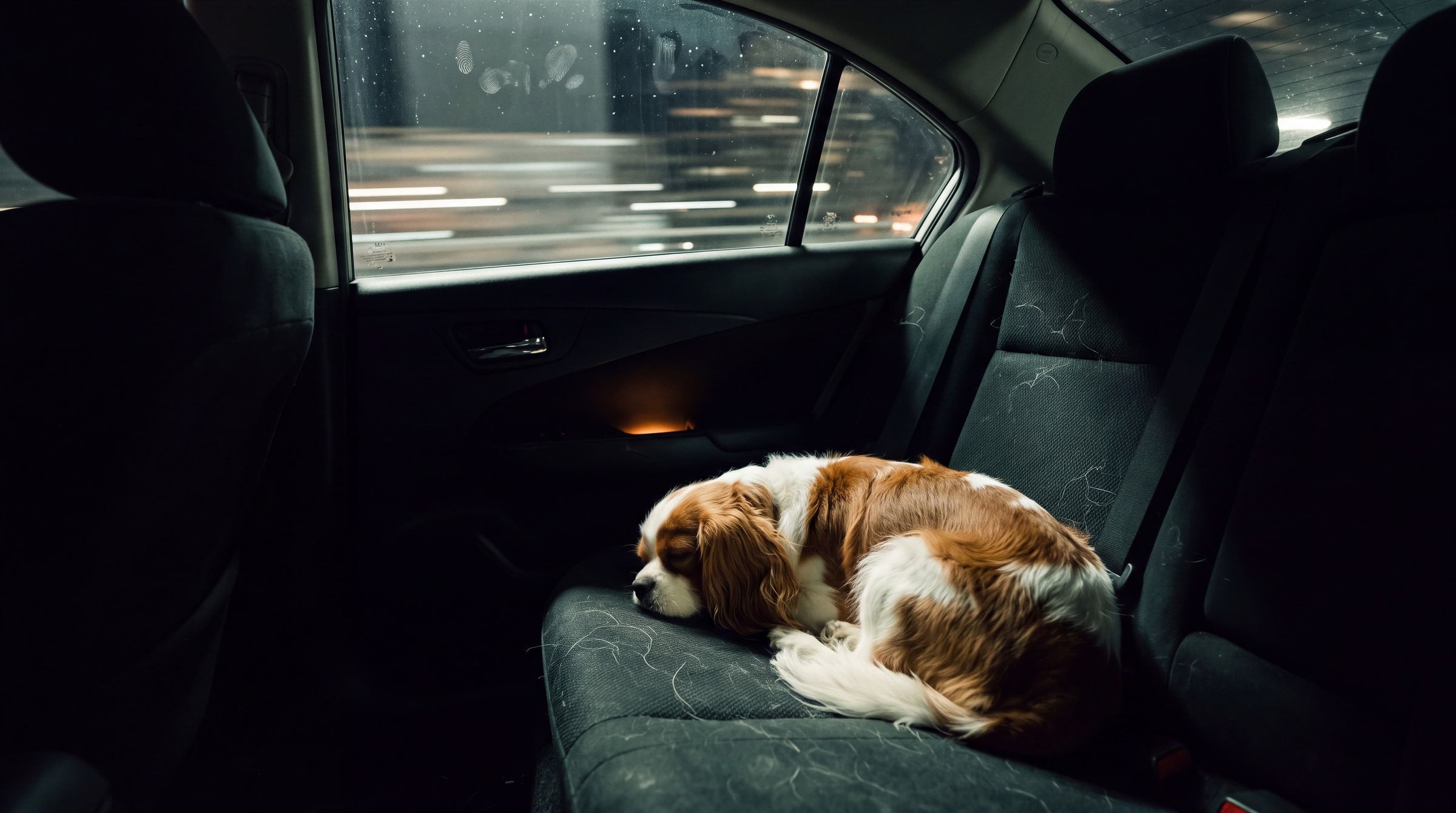
The size of dog car seat you need is decided by two measurements: your dog’s back length, taken from the base of the collar to the base of the tail with the dog standing, and your dog’s weight. Match both against the seat’s stated figures. If the dog exceeds either one, the seat is the wrong size, and breed names will not tell you which way it goes.
Which two measurements actually decide it?
Back length and weight, in that order of usefulness. Back length decides whether the dog fits the footprint — whether it can lie down without hanging over an edge or curling into a shape it will not hold for an hour. Weight decides whether the base and its supports are working within what the manufacturer has specified.
Height matters less than people expect for a booster, because the point of a booster is to raise the dog rather than to enclose it. It matters a great deal for a carrier with a fixed roof, where a dog that cannot stand up without ducking will not settle.
How do you measure a dog’s back length?
Stand the dog on a level floor, on all four feet, and measure in a straight line from the base of the neck where a collar sits to the base of the tail. Do not follow the curve of the spine and do not include the tail. Use a soft tape if you have one; a piece of string marked with a thumb and then held against a rigid rule works just as well and is easier with a dog that will not stand still.
Two things go wrong here. The first is measuring a sitting dog, which shortens the reading substantially. The second is measuring to the tip of the tail, which lengthens it. Both errors are large enough to change the answer.
Take the measurement twice, on different occasions if the dog is uncooperative, and use the larger figure. A dog that measures at the very top of a seat’s range on a good day will be over it on a day when it wants to stretch out.
How do you weigh a dog at home?
Stand on a bathroom scale, note the reading, pick the dog up, stand on the scale again, and subtract. This is accurate enough for the purpose and is the only method that works for most people without a trip to a clinic.
For a dog too large to lift comfortably, most veterinary practices will let you use the walk-on scale in reception without an appointment, and many pet shops have one. Weigh the dog rather than estimating from the last time it was weighed — weight drifts, and a seat chosen against a figure from a year ago is a seat chosen against a different dog.
Does breed tell you anything useful?
Not enough to rely on. Breed gives you a range, and the range is wide enough to straddle most size boundaries. Two dogs described by the same breed name can differ by half again in weight and by several inches in back length, and mixed dogs are wider still. Every sizing chart that starts from breed is compressing a distribution into a label, and the compression is where the mistakes come from.
Use breed to know roughly what you are dealing with before you own the dog. Once you own the dog, measure the dog.
What if the dog is between two sizes?
Size up if you are between sizes on back length, and treat the weight figure as a hard edge rather than a suggestion. Those are different rules for a reason. A dog with a little extra floor space has somewhere to shift to; a dog over a stated weight limit is loading a structure past what it was specified for, and no amount of extra room compensates.
How do you check a seat’s stated size against your measurements?
Look for the interior dimensions rather than the exterior ones. The outside of a seat includes its walls, its padding and its frame, and none of that is space the dog gets to use. A seat that sounds generous from its outside measurements can be tight inside, and the difference is not a small one on a padded product.
What does Gemnye publish, and what is still missing?
Gemnye publishes the seat’s overall dimensions, its cushion elevation and a maximum dog weight of 35 lb on the seat’s own page. What it still does not publish is the interior seat dimension.
The weight figure is worth being precise about. It was withdrawn in August 2026, because the number then in circulation came from the manufacturer’s marketing images rather than from its specification sheet, and it was restored on 25 August when the company confirmed it. Gemnye states it as the maximum weight it publishes and does not describe it as a structural limit or as the result of a test, which is a narrower claim than most sizing charts make.
The interior dimension is the one still missing, and it is the reason the Fit Ruler on the product page — the tool that takes your two measurements and returns a verdict — is still in a declared out-of-service state. It decides on weight and on back length, it now has one of those two, and it says so on the page rather than returning a verdict built on a guessed second number.
That is an unsatisfying answer to give on a page about sizing, and it is the true one. A sizing tool that invents its own limits is worse than a sizing tool that admits it is waiting, particularly on a site whose main argument is that it does not guess.
Does a bigger seat cause any problems of its own?
Yes, two. A larger seat takes more of the rear bench, which matters if anyone else is sitting back there, and it raises a small dog higher relative to the window line, which some dogs like and some do not. A dog that is anxious about movement outside the window may settle better lower down.
The second is tether geometry. A larger footprint means the dog can sit further from its anchor point, so a tether set for a smaller seat will be too long in a bigger one. Re-set the tether length whenever the seat changes, using the same test: the dog can sit, stand and lie down, and cannot reach the front.
Before you buy any of it
Read fit and safety first if you have not. It sets out what this category of product is — a containment and comfort booster that raises a small or medium dog and gives it a defined space — and what it is not, which is a crash restraint of any kind. Sizing correctly matters for comfort and for containment. It does not turn a booster into something it is not.
If you are also wondering whether any of this is legally required where you live, the answer for most US drivers is that it is not, and the state-by-state detail with each statute linked is on dog restraint laws by US state.
Sources
Read 21 August 2026.
- Gemnye product specification and the Fit Ruler’s current state — the seat
- What this category of product is and is not — fit and safety
- Restraint law across all 51 US jurisdictions — dog restraint laws by US state, reviewed 21 August 2026