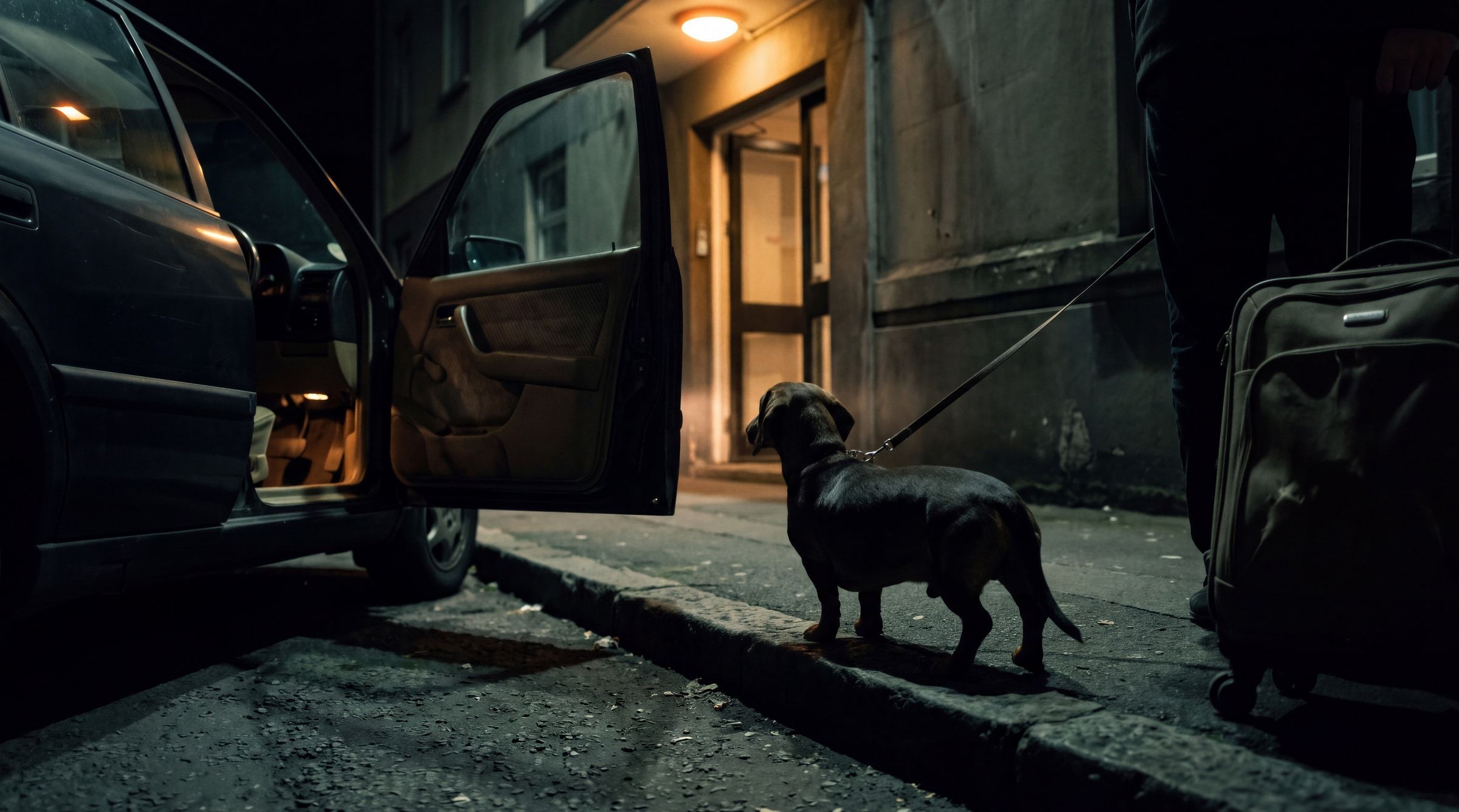
A dog car seat belongs on the back seat, secured with the vehicle’s own belt, with the dog tethered by a harness rather than a collar. The front seat is ruled out by the passenger airbag, which fills the space a booster seat would occupy. This holds whether or not the airbag can be switched off, because the switch is easy to forget and forgetting it is not a recoverable mistake.
What the airbag guidance actually says
Florida’s Department of Highway Safety and Motor Vehicles tells drivers that a rear seat is the better place for any child restraint, and that a deploying passenger airbag would crush a rear-facing seat installed in front of it.
That guidance is written about children. The agency says nothing about dogs and nothing about this product, and we are not going to pretend otherwise. What carries across is the mechanism rather than the finding: a booster raises whatever sits in it and moves it nearer the dashboard, into the space the airbag fills. The same geometry, a different occupant.
We say that carefully because the alternative is the thing this category does badly. It would be easy to quote a highway agency and let a reader assume the agency was talking about dogs. It was not, no agency we can find is, and a sourced sentence used to imply an unsourced one is worse than no source at all.
Can the airbag simply be switched off?
Some vehicles have a passenger airbag cut-off, usually a key-operated switch in the glovebox or on the dashboard end. Where one exists it does what it says.
It is still not the answer here, for a reason that has nothing to do with the switch working. The switch has to be correct on every journey, including the one where somebody else moved the seat, or a passenger rode in front last week, or the car went in for a service. A rear bench needs no setting, cannot be left in the wrong state, and does not depend on anybody remembering anything. Prefer the arrangement that is right by default over the one that is right when checked.
Why the back bench
Three things recommend it, and none of them is a safety claim.
The first is geometry. The rear bench is a flat, deep surface with belt anchor points at both outboard positions, so a seat with a belt path has something to route through and something to pull against. The front seat is contoured for a human torso and slopes differently.
The second is distraction. A dog in the front is inside the driver’s field of view and within reach of the wheel, the gear selector and the driver’s arms. Highway safety offices in Maryland and Utah both list pets loose in the vehicle among the ordinary causes of distracted driving, alongside eating, grooming and reaching for objects. That is a general finding about attention rather than a finding about this product, but it is the whole reason position matters at all.
The third is that a dog on the rear bench is behind the driver rather than beside them, which changes what happens when the dog wants attention. It still wants attention. It just cannot get it by climbing onto an arm.
Never the centre console
The centre console is the other position to rule out, and it is worth naming because it looks reasonable. It is a flat surface at roughly the right height, it is central, and a small dog sits on it happily.
It also puts the dog level with the gear selector, inside the arc the driver’s right arm sweeps through, and directly beside the handbrake. There is no belt anchor there and nothing to route a belt path through, so a seat placed on a console is resting rather than secured. It is the worst of both positions: the distraction of the front, without even the belt geometry of the front.
Where on the back bench
An outboard position — behind the front passenger or behind the driver — gives you a belt and a headrest to work with. The centre rear position often has a lap belt only and, in many cars, no headrest posts at all, which removes both of the anchors the seat uses.
Behind the front passenger is the easier of the two to reach from a stop, and it keeps the dog out of the mirror’s centre view. Behind the driver keeps the dog further from the kerbside door when a passenger gets out. Either works. The one that does not is the middle, and only because of what is missing there rather than anything about the position itself.
The open truck bed is the other wrong place
Worth stating because it is the one location where the law, in some states, has a direct opinion. California Vehicle Code § 23117 restricts carrying an animal in the open load space of a vehicle unless it is cross-tethered or contained, and a minority of other states carry comparable provisions. The state-by-state reference lists which, each cited to its own official code.
Restraint inside the cabin is a different question and, in most of the United States, not regulated at all. Hawaii is the closest thing to an exception: Haw. Rev. Stat. § 291C-124(b) reaches a driver with a dog on their lap rather than requiring restraint generally. That is a narrow provision about the driver’s control of the vehicle, not a rule about where a dog seat goes.
Once it is on the back bench
Route the vehicle belt through the seat’s belt path and buckle it as normal, so the unit stays where you put it. Pass the adjustable straps around the headrest posts and take up the slack until the seat no longer rocks. Then clip the tether to your dog’s harness, never to a collar, and shorten it until the dog can sit, stand and turn without reaching the front of the cabin.
The full installation sequence is on the product page, step by step. None of it needs tools.
What this does not do
A booster seat contains a dog and raises it to window height. It is not a crash restraint, it holds no independent certification, and no booster seat of this type holds one. The only certification programme in this category covers harnesses, carriers and crates, and fit and safety sets out what that means and links to the certifying organisation’s own list.
Getting the position right is worth doing on its own terms: it reduces distraction, it keeps the dog out of the footwell, and it puts the animal somewhere it can settle. Those are the things position actually changes.
Sources
Read 21 August 2026. Each links to the official page it came from. Reviewed twice a year, and whenever a cited page changes.
- Air bag warning for children — rear seats, and rear-facing restraints in front of a passenger air bag — Florida Department of Highway Safety and Motor Vehicles
- Common causes of distracted driving, including pets in the vehicle — Maryland Highway Safety Office
- Distracted driving, people distractions — Utah Highway Safety Office
- California Vehicle Code § 23117, transporting an animal in a vehicle’s load space — California Legislative Information
- Hawaii Revised Statutes § 291C-124, obstruction to driver’s view or driving mechanism — Hawaii State Legislature
- Restraint and open truck bed law across all 51 US jurisdictions, each cited to its own official code — dog restraint laws by US state, reviewed 21 August 2026
- What this seat is, what it is not, and why a tested harness belongs alongside it — fit and safety
- The belt path, the headrest straps and the installation sequence — the seat