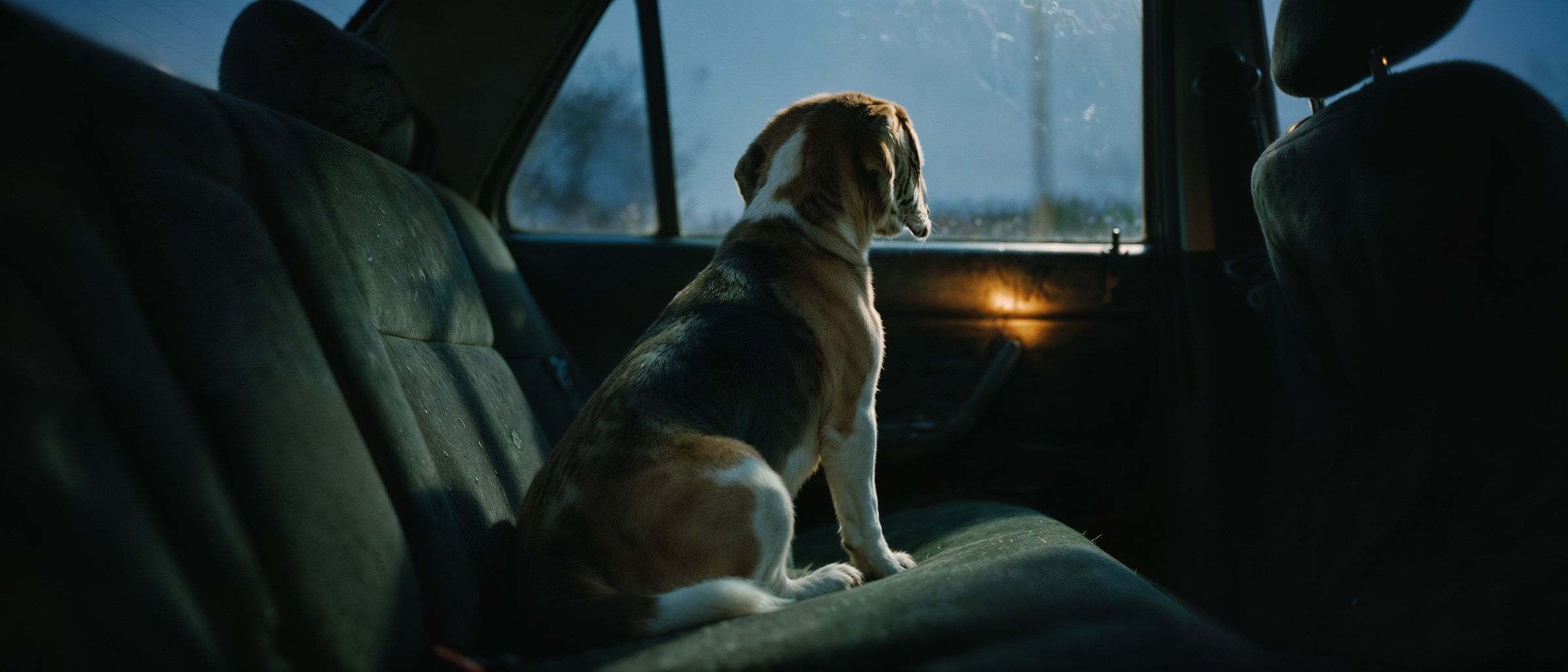
To secure a dog in a car with a seat belt, fit the dog a harness, clip a short tether between the harness’s back or chest ring and the vehicle’s belt or a belt-mounted anchor, and shorten the tether until the dog can sit, stand and lie down without reaching the front. The belt is the anchor point. The harness is what carries the load.
What does the seat belt actually do here?
It gives you a fixed anchor in a moving vehicle, and that is all. The vehicle belt was engineered around adult human geometry and a retractor that locks under load. Used with a dog, it is doing a much simpler job: holding one end of a tether still while the dog moves at the other end. Every question about how well the arrangement works is a question about the harness and the tether, not about the belt.
This is worth being plain about because a lot of product copy in this category implies the opposite — that routing a vehicle belt through something confers the belt’s engineering onto the dog. It does not. A belt through a poorly made tether is a poorly made tether with a good anchor.
Which belt path should you use?
Use the lap portion, and use a rear seating position. Thread the lap belt through the tether’s loop or through the belt path built into a carrier or booster, then buckle it and pull the shoulder portion all the way out until the retractor clicks into its locked mode, then feed the slack back in. In most cars that converts the belt from a free-moving inertia reel into a fixed strap, which is what you want for anything that is not a person.
Why never clip the belt to a collar?
Because a collar puts every load on the neck. A tether attached to a collar turns any sideways lunge, any hard stop, any dog deciding to change position at the wrong moment, into a load on the trachea. A harness spreads the same load across the chest and ribcage.
This is the least negotiable item in this whole article, and it is also the most commonly ignored, because collars are already on the dog and harnesses are one more thing to fit. Fit the harness. If the dog wears a harness for walks already, that is the one to use — a harness the dog is used to is a harness it will settle in.
How long should the tether be?
Short enough that the dog’s shoulders cannot pass the front edge of the seat. That is the working test, and it usually produces a tether much shorter than people expect. Set it with the dog in position, then let the dog stand up, turn around and lie down. All three should be comfortable. Reaching the front should not be possible.
A long tether has two problems. The obvious one is that the dog gets to the footwell or the front seats. The less obvious one is that in a hard stop, a longer tether means more distance travelled before the tether does anything at all, and the arithmetic there is not in the dog’s favour. Short is better on both counts.
Should a dog ever ride with the belt in the front seat?
No. Put the dog on a rear seat. The passenger airbag deploys into the space a dog would occupy, at a speed and force set for an adult human, and whether the airbag can be switched off is not the point — the switch is easy to forget and the consequence of forgetting is severe. This site’s article on where a dog car seat should go sets out the reasoning in full.
Several states put this in their own driver guidance rather than in statute. Oregon’s driver manual instructs drivers not to hold an animal in their lap or arms while driving. Hawaii puts it in the code: § 291C-124(b) bars holding an animal in the driver’s lap, or allowing one in the driver’s immediate area, where it interferes with control of the vehicle.
Does a booster seat change how the belt is used?
It adds a second job for the belt without removing the first. A booster is belted to the bench through its own belt path, and the dog is then tethered inside it by its harness. The belt holds the seat. The tether holds the dog. Two separate connections doing two separate things, and a booster that is belted in while the dog rides loose inside it is only doing half the work.
What a booster of this type does not do is act as a crash restraint. The Gemnye seat is a containment and comfort booster: it raises a small or medium dog so it can see out, keeps it out of the footwell and off the driver’s lap, and gives it a defined space. It has not been through any independent testing programme, and no booster of this type has. That is set out at length on fit and safety, which is the page to read before deciding whether this category is the right one for your dog at all.
What does the law say about any of this?
Very little, in most places. No US jurisdiction whose official code could be read carries a general requirement that an animal in a moving vehicle be restrained. What nearly every state does have is a careless or inattentive driving statute, and a number of states name animals directly in official guidance — Maryland’s highway safety office lists animals among the passengers that take attention off the road; Maine’s motorist handbook tells drivers to keep pets in a carrier rather than loose in the vehicle.
Eight jurisdictions restrict carrying a dog in an open truck bed, which is a separate question from the cabin and answered separately. The full picture is on dog restraint laws by US state, with each statute cited and linked, and with the jurisdictions whose codes could not be reached marked as such rather than guessed at.
A working order to do it in
Fit the harness first, at home, and let the dog wear it indoors for a while. Fit the tether to the harness and set its length in the parked car with the engine off. Belt the anchor or the seat in and lock the retractor. Then take a short drive that ends somewhere the dog wants to be. Getting the hardware right in a stationary car takes ten minutes; getting it right on the hard shoulder takes considerably longer.
Sources
Read 21 August 2026. Each links to the official page it came from.
- Hawaii Revised Statutes § 291C-124, obstruction to driver’s view or driving mechanism — Hawaii State Legislature
- Oregon Driver Manual, safe and responsible driving — Oregon Department of Transportation
- Maine Motorist Handbook, driver distractions — Maine Secretary of State
- Common causes of distracted driving — Maryland Highway Safety Office
- Restraint and open truck bed law across all 51 US jurisdictions — dog restraint laws by US state, reviewed 21 August 2026